The Emerald Tablet, also known as the Smaragdine Table, or Tabula Smaragdina, is a compact and cryptic piece of Hermetica reputed to contain the secret of attaining the prima materia through transmutation. It was highly regarded by European alchemists as the foundation of their art and its Hermetic tradition. Although Hermes Trismegistus is the author named in the text, the first known appearance of the Emerald Tablet, is in a book written in Arabic between the sixth and eighth centuries… The text was first translated into Latin in the twelfth century. Numerous translations, interpretations and commentaries followed.
The layers of meaning in the Emerald Tablet have been associated with the creation of the philosopher’s stone, laboratoryexperimentation, phase transition, the alchemical magnum opus, the ancient, classical, element system, and the correspondence between macrocosm and microcosm.
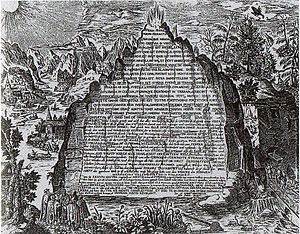
The Emerald Tablet of Hermes Trismegistus.
The Emerald Tablet, also known as the Smaragdine Table, or Tabula Smaragdina, is a compact and cryptic piece ofHermetica reputed to contain the secret of the prima materia and its transmutation. It was highly regarded by Europeanalchemists as the foundation of their art and its Hermetic tradition. Although Hermes Trismegistus is the author named in the text, the first known appearance of the Emerald Tablet is in a book written in Arabic between the sixth and eighth centuries. The text was first translated into Latin in the twelfth century. Numerous translations, interpretations and commentaries followed.
The layers of meaning in the Emerald Tablet have been associated with the creation of the philosopher’s stone, laboratoryexperimentation, phase transition, the alchemical magnum opus, the ancient, classical, element system, and the correspondence between macrocosm and microcosm.